Activity
Mon
Wed
Fri
Sun
May
Jun
Jul
Aug
Sep
Oct
Nov
Dec
Jan
Feb
Mar
Apr
What is this?
Less
More
Memberships
گارد آزادی
300 members • Free
Liberty Politics Discussion
4.1k members • Free
147 contributions to Liberty Politics Discussion
11h •
Is Regime change still on the table?
At the start of operation epic Fury, Trump promised the people of Iran a chance at taking over their government and replacing it with something for the people by the people, but now that vision seems further than ever. My question is wether regime Change is still on the table or should Iranians stop hoping for change and settle for the current regime cutting a deal that keeps the west satisfied for another decade or so?
1 like • 10h
"Further than ever"? Can you tell me a specific DATE where we were closer to regime change than now?

20h •
those weapons..
one more thing on the “kurds”, if the kurd separatists, would have the american weapons 1. they would have already used it and it became viral. 2. the anti Trump media would make so much news out of it. 3. also let’s say they have it and they are waiting to a command from above to use it, the irgc heads are coming and going so fast, that they have no time to make a move on this
1 like • 20h
I think it's a distraction. I love how separatists have been getting used for distractions consistently through the course of events lol
0 likes • 19h
@Daniel Dom I hope it's a ruse for something actually good ☺️
21h •
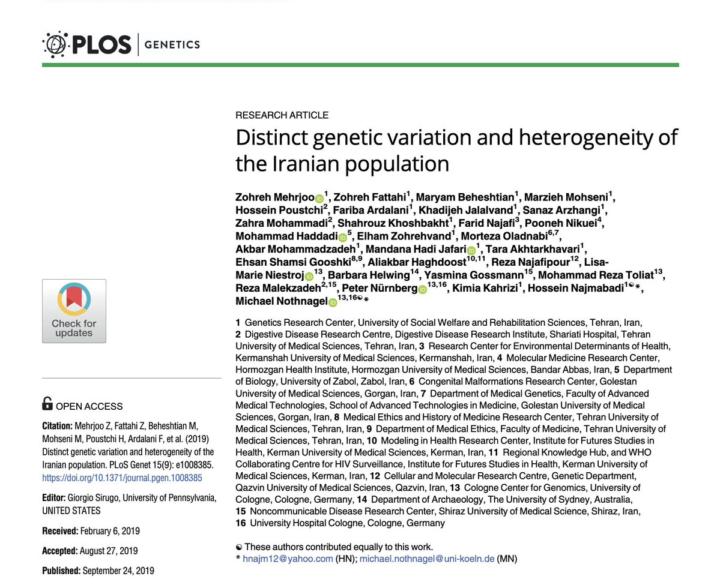
Genetic variation of the Iranian population
https://journals.plos.org/plosgenetics/article?id=10.1371/journal.pgen.1008385 Genetic Study of Iranians and The CIC SUMMARY Iranians across Iran share similar DNA and are distinguishable from populations in neighbouring countries. DETAILS This research was conducted in Iran and is the most comprehensive genetic study of Iranians to date. The findings in this research are based on a study of 1,021 individuals sampled from 11 "ethnic" groups. There exists a genetic group called the Central Iranian Cluster or CIC, for short. CIC is a genetic group in Iran whose ancestry dates back thousands of years, with roots reaching the Bronze Age, about 5,000 years ago. This indicates a stable genetic continuity across the Iranian plateau. The overwhelming majority of Iranians fall into the CIC, which means they have similar ancestry and genetics that distinguishes them from non-Iranians. When researchers sampled people from regions inhabited by Persians, Kurds, Lurs, Gilaks, Mazanderanis, Azeris, Iranian Arabs, and others, they found that they belonged to the Central Iranian Cluster. There is diversity within this CIC, but Iranians exhibit this variation regardless of which part of Iran they are from. For example, you can find individuals with light or dark complexions among both Persians and Gilaks. They cannot reliably be distinguished from one another based on appearance alone. Therefore, identifying as Persian, Lur, Azeri, Kurd, or Mazanderani does not reveal a clear genetic distinction. These are cultural and linguistic identities. Genetically, however, these populations fall within the same Central Iranian Cluster. Azeris and Iranian Arabs fall into the Central Iranian Cluster, not Turkic or Arab genetic groups, respectively. Kurds in Iran also definitely fall in the Central Iranian Cluster. The study specifically points to the concept of language adoption rather than population replacement.
1 like • 21h
Separating kurds, lurs, baluchis, gilakis, and other IRANIAN "minorities" is not an Iranian thing. This comes from outside. Sources that do not have the interests of Iran and Iranians at hand.
1-10 of 147
@nare-bars-3248
Iranian Armenian, now US citizen. Atheist. Advocate for sanity and liberal values.
Also known interchangeably as an Israeli plant, bot and hindu 💅
Active 10h ago
Joined Oct 24, 2025
Powered by