Activity
Mon
Wed
Fri
Sun
May
Jun
Jul
Aug
Sep
Oct
Nov
Dec
Jan
Feb
Mar
Apr
What is this?
Less
More
Owned by Sterling
This group is designed for the discussion of the Vagus Nerve, techniques to stimulate it, and the benefits of doing so.
Ultra School is a repository for information published by Sterling Cooley, as an online training platform for using Ultrasound.
Memberships
Biotech Career Accelerator
2 members • Free
Skoolers
192k members • Free
Synthesizer: Free Skool Growth
39.5k members • Free
Accelerator
9k members • Free
333 contributions to Vagus School

15h •
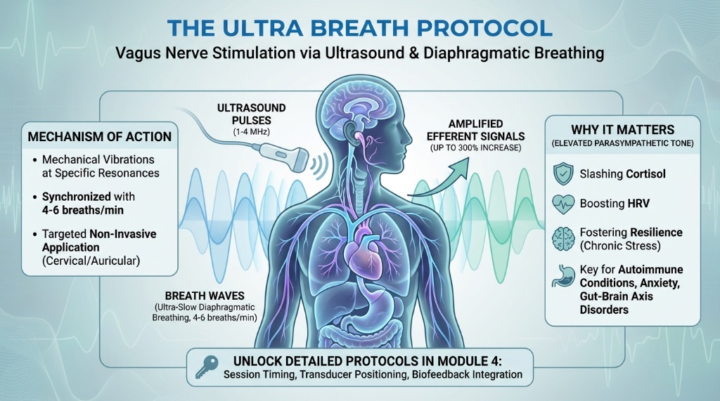
Unlock Health With Ultra Breath: Vagus Nerve Stimulation Protocol
Ultra Breath Protocol: Ultrasound + Vagus Nerve. Diaphragmatic breathing synced with ultrasound. Frequencies target vagus nerve stimulation. The vagus nerve regulates HRV, digestion, inflammation, and mood. Mechanical vibrations at 1-4 MHz are key. Synchronize 4-6 breaths/minute with pulsed ultrasound. Apply non-invasively to cervical or auricular branches. Amplify efferent signals by up to 300% (studies). Elevate parasympathetic tone; reduce cortisol. Boost HRV, foster resilience, and counter chronic stress. This is critical for autoimmune, anxiety, and gut-brain disorders. Protocol includes session timing, transducer positioning, and biofeedback. Optimize vagal tone and health. Ultrasound pulses travel the vagus nerve. Breath waves expand health. https://www.skool.com/vagus/classroom/896c2c69?md=a0511fa1e8a8425d87c5490766831cdb
2
0

2d •
I had an incident and VNS helped
Last week I did something that over stimulated myself and my heart rate got stuck at 150BPM, @55 yrs old, not a good thing, but I do HIIT and it does get up to there. It may have been terminal if my HRT stayed up there, I called an ambulance and as soon as they put a drip in my arm my HRT went down, I went to the hospital and got checked out, but my HRT was still abit high and one of the DRs was saying that stimulating my vagus nerve is the thing to bring it down if it ever happened again. After I got home my HRT still seemed to be racing and it was still abit elevated, so over the next 3 evenings before bed I did 5 minutes each side on my vagus nerve using my US2000 ultrasonic device and my HRT is back to normal, so I'm glad that I have proven the stimulation has worked. Hopefully my HRT will be back in its normal rhythm now, but at least I know what to do in the future if it happens again.
2 likes • 1d
Wow Kevin, that's incredible! You may have saved yourself a few more trips to the emergency by actually having access to vagus nerve stimulation. This is amazing news. Thank you for sharing all of this ! I would also say there's a distinct possibility that, I mean, obviously, electrolytes since if they gave you saline that helped bring things down too. Another way to get your vagus nerve to work is the Valsalva squeeze. Here are two videos that can demonstrate: 1. How to use a plastic large syringe to blow into 2. Just blowing into the back of your hand That pressurization of your diaphragm squeezes your vagus nerve and can also make it release acetylcholine, which will immediately initiate the vasovagal response, which can slow down your heart rate really well. Certainly I'm happy to hear that ultrasound is helping but if you're out and about and this happens again, worry not because you can stimulate your vagus nerve completely with your own breath and squeezing. I hope you learn this method seriously and please post a follow-up in another week or two and let us know if regular ultrasound has helped keep this in check. https://www.youtube.com/watch?v=k5o26XwpCt4
2 likes • 1d
@Kevin Bannister yeah just to be clear none of those videos are really what I would consider deep breathing. They're more like taking a big deep inhale of air but then you hold it in your body. You can't let any air escape and then you start squeezing it like you're trying to compress all the air in your body, creating a big tank of compressed air in your body, like you're trying to squeeze oxygen into a diamond with your own body. You have to use every muscle and bone and organ and you basically squeeze that shit so hard that it force activates your vagus nerve. It's just one breath. It's not really the same when I think of deep breathing. I think of taking lots of breaths. This is the furthest thing from taking a lot of breaths; this is one single compressive diaphragmatic squeeze. Hope that helps.
23d •
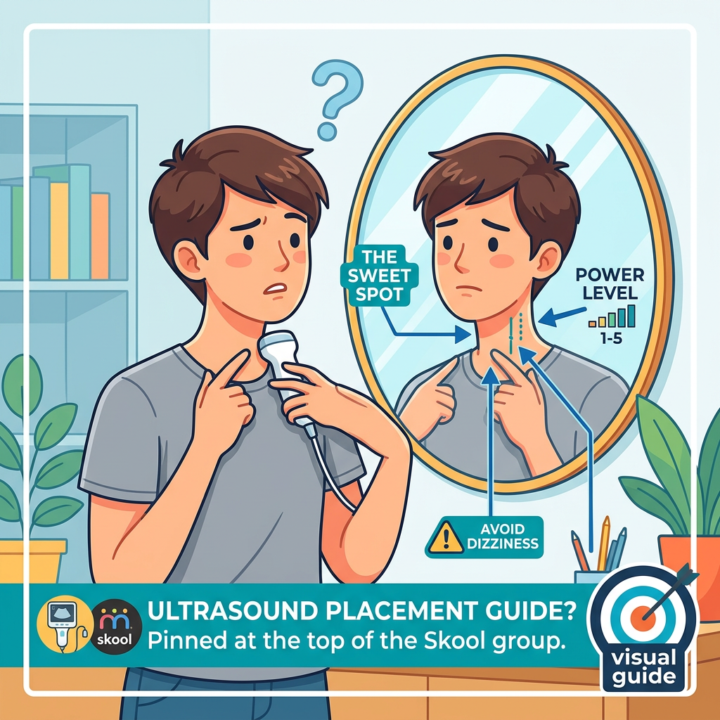
📸 The #2 Question: "Got Any Pictures of How to Use This Thing?" (Yes! Here is the Visual Guide + The Golden Rules)
You got your device (hopefully from the pinned post above! 👆), and now you're staring at it thinking, "Okay... but where does this thing actually go on my neck?" It is the second most common question I get, and the answer is critical. Slapping the ultrasound on the wrong spot is like trying to charge your phone with the wrong cable—it just won't work, and you might get a weird error message (dizziness, tingling, etc.). I have built a whole module dedicated to this, complete with diagrams and a video guide. It covers the exact anatomy, the "mirror trick," and how to avoid overstimulation. 👉 [CLICK HERE FOR MODULE 3: Ultrasound Setup & Neck Placement] The "Cheat Sheet" Before You Click: Since you are here asking for pictures, here is a quick preview of what is waiting for you inside that module so you can get it right the first time: 1. The Setup (Don't Skip This!) - Gel is Boss: Do not turn the device on without it. It is not lotion; it is the conductor. - Warm it Up: Cold gel is a shock to the system. Warm the bottle in your hands first for a spa-like vibe. 2. The "Sweet Spot" Placement - The Location: It is on the left side of your neck (you can do the right side ONLY when you're absolutely sure you can find the left side Vagus Nerve). - The Landmarks: You are aiming for the point between the crease behind your jawline, the bottom of your earlobe, and the big neck muscle (sternocleidomastoid). - The Mirror Trick: Use a mirror to watch the placement. If you feel a tingle or your voice wobbles, you are hitting a nerve—move slightly inward (towards your windpipe). 3. The 5-Minute Goldilocks Rule - Minute 0-1: Level 1 (Gentle introduction) - Minute 2-3: Level 2-3 (Building warmth) - Minute 4-5: Level 4 (The "Ahhh" zone) - Red Flag: Nausea or headache? Stop immediately and sip cold water. Bonus: When to Do It (Module 4 Sneak Peek) Timing matters! Most people love this before bed for deep sleep, but you can also do a low-intensity session in the morning for "alert calmness" without the jitters.
1 like • 1d
@Lynne Marie okay so when using the US2000 pro, you want to do it on a start low and then medium. Generally you're probably never going to go high on the US2000 pro on your neck; some do because they can handle a lot of stimulation but that's a lot. High ultrasound on the US2000 pro is usually best reserved for the liver, the abdomen, the spleen, etc.
0 likes • 1d
@Laurence Zankowski honestly Laurence, I think you're spot on. I think it's a great idea. I'm gonna start thinking about if I could recruit a model to allow me to write on their body with one of those surgical pens or whatever and demonstrate the exact placement of the ultrasound. That's a great idea. Thank you so much.
2d •
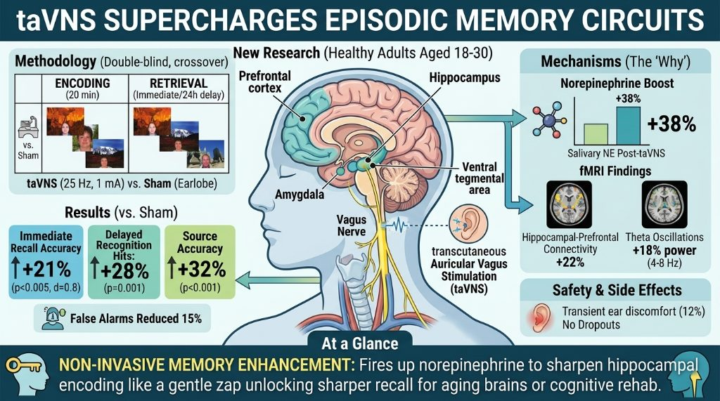
New Study: Boost Memory Accuracy By 32 Percent With Vagus Nerve Stimulation
Recent clinical research confirms that transcutaneous auricular vagus nerve stimulation (taVNS) significantly enhances episodic memory encoding in healthy adults. In a double-blind study of 48 participants, 25 Hz stimulation delivered during the encoding phase resulted in a 21% increase in immediate recall accuracy compared to sham controls. Long-term metrics were equally compelling: delayed recognition hits improved by 28%, source memory accuracy rose by 32%, and false alarms fell by 15%. The mechanism is driven by a 38% surge in salivary norepinephrine. This facilitates a 22% increase in hippocampal-prefrontal connectivity and higher theta oscillation power (4-8 Hz). These results position taVNS as a high-precision tool for strengthening memory circuits non-invasively. The intervention was well-tolerated, with zero study dropouts. This protocol offers a scalable framework for cognitive rehabilitation, effectively unlocking sharper recall for aging populations or neurological recovery. https://www.nature.com/articles/s41598-021-96280-x https://pubmed.ncbi.nlm.nih.gov/33219219/ https://www.nature.com/articles/s41598-020-72141-y https://pubmed.ncbi.nlm.nih.gov/41687811
2 likes • 1d
@Michael Wagner Michael nailed it. That's exactly what it is. Encoding is when your brain starts storing the memory in your brain. It's a specific type of, like, when the information is raw in your brain and your brain then starts to compress the important parts to be stored in long-term memory. That's kind of what the encoding phase is. It's a critical part of the memory process.
5d •
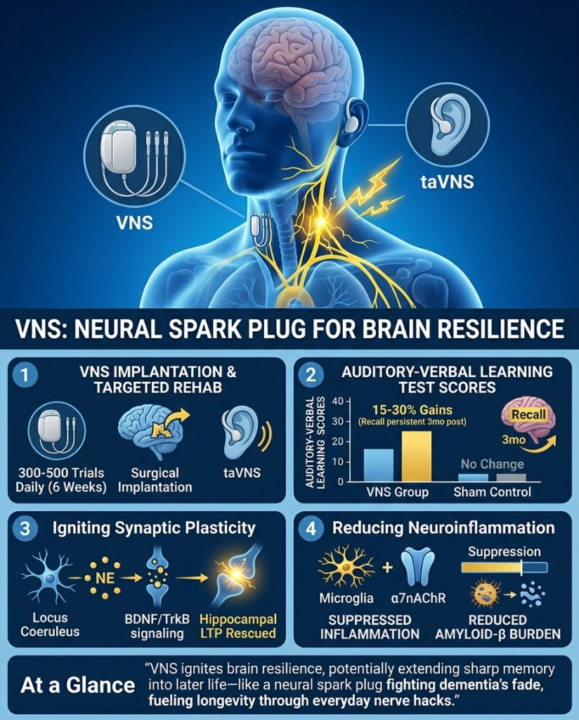
Memory Boosted By 30 Percent For 3 Months With This Vagus Nerve Technique (Stimulating it)
Vagus Nerve Stimulation (VNS) is emerging as a potent physiological intervention against Alzheimer’s Disease and age-related cognitive decline. In trials, patients with early Alzheimer’s paired these gentle "zaps" with memory drills. The result? A 30% boost in verbal learning that stuck around for months. That’s like suddenly remembering where you put your keys and the name of your third-grade goldfish. The Vagus nerve triggers a flood of norepinephrine—nature’s own "Pay Attention!" juice. It also sends in a molecular cleaning crew to scrub away brain fog and inflammation. We’re moving toward a future where we can "hack" our way back to a sharper mind. Who knew the secret to cognitive longevity was literally getting on your own nerves? These improvements persisted three months post-treatment, while sham controls remained stagnant. Mechanistically, VNS triggers the locus coeruleus to release norepinephrine, enhancing synaptic plasticity via BDNF/TrkB signaling. It also suppresses neuroinflammation by activating α7nAChR on microglia, reducing amyloid-β burden. Non-invasive variants (taVNS) are now replicating these results, offering a scalable path to cognitive longevity. https://www.bozemandailychronicle.com/ap_news/conversation/vagus-nerve-stimulation-shows-promise-as-a-way-to-counter-alzheimer-s-disease--and/article_bace70cf-a4c0-52b4-895c-2eb604615536.html
0 likes • 1d
@Laurence Zankowski so here's the link to this actual post here on school if they want to get there. https://www.skool.com/vagus/memory-boosted-by-30-percent-for-3-months-with-this-vagus-nerve-technique-stimulating-it
0 likes • 1d
@Laurence Zankowski I know it can be challenging if you're on a mobile device to get the links to these posts to be able to share it. One thing I would recommend actually is if you follow me on Facebook, I post all the same links. I also post them to LinkedIn and also to X and Instagram so you should be able to find this stuff all over the web on any of my social media places. That can make it a little bit easier to share out for people. Cheers.
1-10 of 333

@sterling-cooley
Vagus Nerve Stimulation Specialist
Admin of Ultra School
Active 5h ago
Joined Oct 15, 2020
ENTP
Seattle, Washington
Powered by