
Write something
Pinned

Jan '23 •
Welcome! 🏁 Start here ...
Hi everyone, Design Sprint Masters is an exclusive community of practice for facilitators interested in facilitating design sprints and problem-framing workshops. Here you can: ✅ Interact and exchange experiences with fellow facilitators ✅ Ask your burning questions and get community help ✅ Talk about design sprints, problem framing, and all things facilitation ✅ Talk about how to run these workshops inside organizations ✅ Access to the DSA Team and one monthly coaching call with one of our experts To make this a worthwhile experience, we encourage everyone to participate actively. Ask questions, start conversations and share your experience. But first things first, introduce yourself using the following template: 👇👇👇👇👇👇 Hi, my name is ......, I’m from ......., and I work as/for/with ...... I bring these things to the community... I want to get these things from the community... For fun, I like to... We’re thrilled to have you here and hope you will get lots of value from the community and have some fun doing it. Yours, DSA Team ❤️

19d •
Is transitioning into AI Facilitation something you're actively exploring?
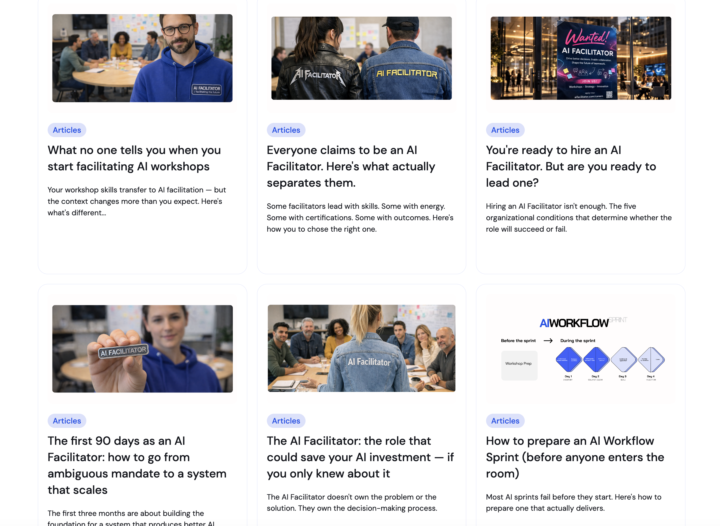
I've been writing a series on AI Facilitation for the DSA blog — and this latest piece is the one I'm most curious to get your take on. It's called "What no one tells you when you start facilitating AI workshops." The core argument: you are not facilitating a team. You are facilitating a group of strangers who don't speak the same language. Is transitioning into AI facilitation something you're actively exploring? I ask because I keep seeing two kinds of facilitators right now. Those who feel pulled toward it ... because clients are asking, the work is there, and it feels like a natural next step. And those who aren't sure - because the AI part feels like a stretch, and they don't want to start something from scratch. But I'm more curious about where you are. Is this a transition you're moving toward — or does it feel like a different world from where you currently work?
Mar 6 •
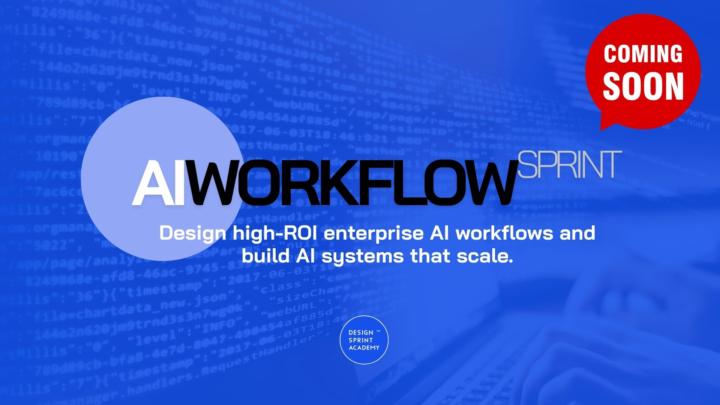
A big update to the Design Sprint Format 👉 AI Workflow Sprint
Hey Design Sprint Masters, As facilitators, we all feel the pressure: workshops only matter if teams act on them. That led me to a basic rethink: what does a facilitator do in an AI-heavy organization? Over the past few months we’ve been shaping what we call the AI Facilitator—along with the tools and methods to help teams make AI decisions with a clear process. In Berlin this month, we’re sharing what came out of that work. It’s the biggest change we’ve made to the Design Sprint format. We’re not calling it a Design Sprint anymore. We call it the AI Workflow Sprint. Why? Because most organizations exploring AI aren’t trying to design new apps. They’re trying to redesign how work gets done: - Where AI should help or take over - Which use cases are worth building So the sprint starts with a real workflow, not a product idea. During the sprint, teams: 1. Map the current workflow 2. Spot where AI could change the process in a meaningful way 3. Redesign the workflow with people + AI together 4. Prototype the new experience 5. Test it with users We kept the core rhythm—diverge, then converge. But the thing you’re designing is the workflow, not just an interface. We’ll teach this for the first time in our AI Facilitator Training in Berlin this month. You should join: https://learn.designsprint.academy/AI-facilitator-training Unfortunately the early bird discount of €500 expires tonight. Until then you can still use code EARLYAI at checkout for €2,000 instead of €2,500.

Feb 21 •
Productivity Tools
Hello fellow facilitators, i have been away as I ave been overwhelming with too much to do. Any advices on good productivity tools and practices, thank uvin advance :)
0
0
Feb 2 •
Why P.A.L.T. belongs in your Product Discovery workshops
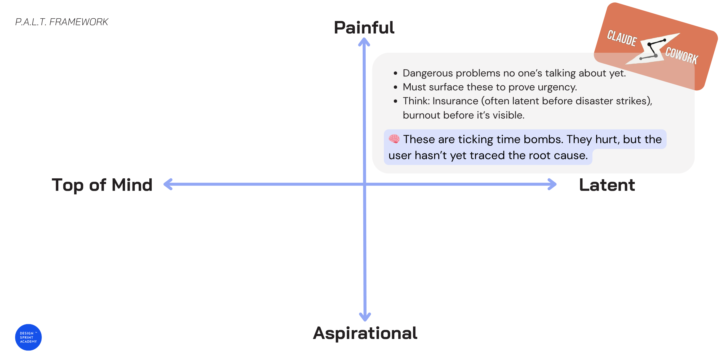
Sometimes the best customer insights are hidden behind workarounds, hacks, substitute solutions. That’s why we created P.A.L.T. at Design Sprint Academy. It helps teams see the unseen — the less obvious problems — and explore territory where competitors aren’t. Proof: Claude Cowork Anthropic didn’t build Cowork because users requested it. They built it because they watched users hack Claude Code (a developer tool) to handle everyday tasks they couldn’t quite describe yet—like organizing files or planning trips. That’s a Painful + Latent sign. What P.A.L.T. stands for: P (Painful): → A problem that hurts, costs time, money, or trust. A (Aspirational): → A desire or wish that would feel good to achieve, but not critical. L (Latent): → A hidden issue or desire the user hasn’t yet recognized or can’t clearly express. T (Top of Mind): → Something the user is already aware of and actively thinking about (or actively looking for solutions). We use P.A.L.T. inside our AI Problem Framing workshop as a filter before teams commit to solutions. It helps them ignore, for a moment, the Top-of-Mind problems (where competitors also focus) and spend time where they can make a unique difference: Painful + Latent. I wrote a deeper breakdown of how Claude Cowork maps to P.A.L.T. (and how to replicate their way of thinking). https://www.designsprint.academy/blog/p-a-l-t---the-framework-anthropic-accidentally-proved-with-cowork Hope you'll find it helpful.
1-30 of 110

skool.com/design-sprint-masters
A place for facilitators to share tips and experiences on design sprints, problem-framing, and design thinking workshops.
Powered by