
Write something
7d •
A little update…
The past few weeks have been heavy. Not the kind of heavy people see… the kind you carry quietly. The kind that sits in your chest, follows you into your thoughts, and makes even the simplest things feel like a fight. Between what’s happening in Lebanon, the memories that come with it, the losses, the images that don’t leave… me at war in Iraq, various critical incidents I’ve dealt with at work….it caught up to me. More than I expected. And I’ll be honest… there were moments I didn’t want to get up. Moments where my mind was louder than anything around me. But here’s the part people don’t talk about. There’s no crowd when you’re fighting that battle. No recognition. No one sees the decision to get up anyway. No one sees you take that breath and push yourself back into the day when everything in you is telling you to shut it down. That’s the real fight. And the past few days, that’s exactly what it’s been for me. Quiet. Internal. Grinding. Running when I didn’t feel like it. Training when my mind was elsewhere. Forcing myself to move, to reset, to take back some level of control. Because I know what happens if you don’t. You don’t need motivation for that fight. You need discipline. You need to make the decision that you’re not staying in that place… even when it would be easier to. Some days it’s not about being at your best. It’s about not giving in. So if you’re in that place right now… understand this: Getting up counts. Taking a step forward counts. Choosing not to stay in the dark… that counts. I’m working through it. Still am. And if you are too… keep going.
Feb 16 •
C.S. Lewis Quote
My latest journal entry (I added emojies to point out certain things) C.S. Lewis wrote: “We make men without chests and expect of them virtue and enterprise. We laugh at honor and are shocked to find traitors in our midst. We castrate and bid the geldings be fruitful.” That quote hits hard. Here’s how I see it, through the lens of war, policing, and leadership. ➡️ We say we want courageous officers. ➡️ We say we want disciplined soldiers. ➡️ We say we want principled leaders. But then we strip away the very traits that make those things possible. ‼️ We mock conviction as rigidity. ‼️ We label strength as aggression. ‼️ We treat standards like inconveniences. ‼️ We replace discipline with optics. And then we’re surprised when moral courage disappears. In the military, I learned quickly that chest isn’t bravado. It’s alignment. It’s the integration of mind, heart, and action under pressure. It’s the ability to stand firm when the environment pushes you to bend. In policing, I’ve seen what happens when we focus only on policy compliance and ignore internal governance. You can train someone in tactics. You can certify them on paper. But if you hollow out character if you don’t cultivate virtue, restraint, honor, and emotional regulation, you create fragility beneath the uniform. ‼️ Hours do not equal readiness. ‼️ Policies do not equal integrity. ‼️ And credentials do not equal courage. ‼️ Virtue isn’t accidental. It’s trained. It’s reinforced in small daily disciplines. In honest AARs where ego doesn’t run the room. In leaders who model calm under pressure instead of performative outrage. In cultures where decency isn’t weakness, it’s the standard. We cannot weaken the internal structure of our people and still expect excellence under stress. If we want enterprise, we must build backbone. If we want loyalty, we must cultivate honor. If we want strength, we must train both character and competence. Leadership isn’t about manufacturing compliance.
Feb 11 •
“I see humans but no humanity.”
Because if we’re honest, this is what can happen in our profession. It happened to me when I was at war. Civilians became like cattle to me. I knew I was going down a dark path. In law enforcement, in the military, in emergency services, we see people at their worst. Over and over again. We see overdoses. We see sudden deaths. We see domestics that spiral into chaos. We see violence, betrayal, addiction, cruelty. If you do this job long enough, something subtle begins to happen. You stop seeing people. You start seeing patterns. You stop seeing fathers. You see “another DV suspect.” You stop seeing a struggling kid. You see “another repeat offender.” You stop seeing pain. You see “another call holding.” Desensitization isn’t a character flaw. It’s a survival mechanism. But if we’re not disciplined, that mechanism becomes permanent. And that’s where the danger lives. Because the moment we lose our humanity, we lose our judgment. We lose our presence. We lose the very thing that separates professional force from reckless force. Control without compassion becomes cold. Authority without empathy becomes brittle. Power without humanity becomes dangerous. I’ve felt it creep in before. After long shifts. After stacked calls. After nights where the heart rate spikes and the mind narrows. The job can harden you. But hardness alone is not strength. Strength is remaining steady under pressure without becoming calloused. Strength is regulating yourself so you don’t let cynicism write your character. Strength is remembering that the person in front of you — even at their worst — is still human. We are allowed to be disciplined. We are required to be decisive. We must be capable of force when necessary. But we cannot afford to lose our humanity in the process. Because the public doesn’t just need strong first responders. They need strong, grounded, self-aware ones. The badge. The uniform. The shield. They don’t give you humanity. You bring that with you.
Nov '25 •
OSINT
I believe we all have different reasons for being here. My interests use OSINT to identify victims and traffickers and general research into cyber-related fields. I find a lot of great info on LinkedIn (that's how I found 'We Fight Monsters'!). If you're interested in learning more about OSINT and it's applications two of the best accounts to follow are Ubikron (https://www.linkedin.com/company/ubikron/) and OSINT Experts Society (https://www.linkedin.com/groups/13047129/). Both have plenty of resources and regularly post items of interest.
Feb 2 •
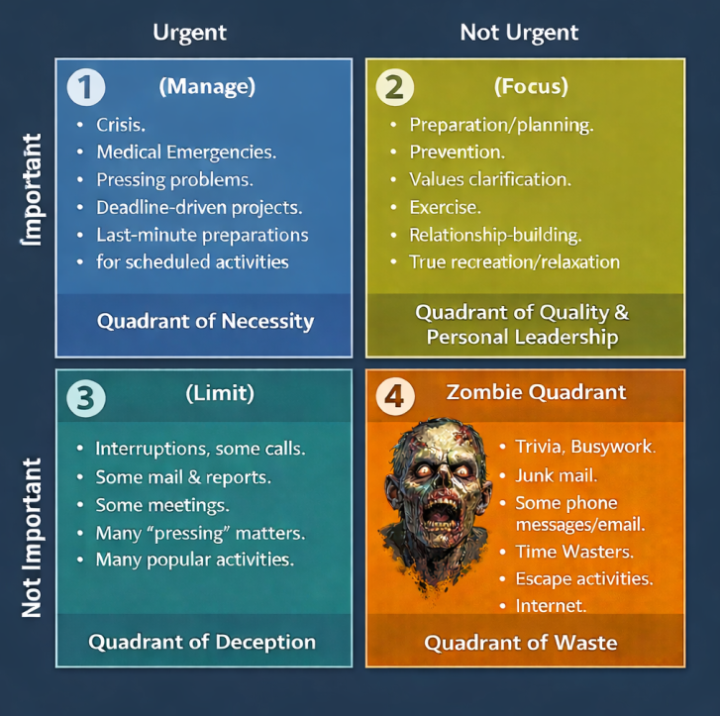
Time Management
Time is one of our most valuable assets. You can't beg, borrow or buy more, so use what you have wisely. Below is an Eisenhower Matrix where tasks are broken out into a 4 quadrant matrix of Urgency and Importance. Manage emergencies (Q1), limit distractions (Q3), avoid the Zombies (Q4) and spend as much time as possible planning and building relationships (Q2). If you intentionally spend time in Q2, you will likely feel better, be more productive and find you have built deeper and stronger connections.
1-30 of 65
skool.com/owenarmy
We train others to combat human and narcotics trafficking, how to turn dope houses into hope houses, and how to transform pain into purpose.
Leaderboard (30-day)
1
+4
2
+1
3
+1
Powered by