Write something
Pinned

Jan 27 •
Welcome, Spartan.
You are here because you’ve decided to stop treating the financial markets like a casino and start treating them like a discipline. My name is Richard J. Wood. I am a 20+ year veteran of this industry, and I’ve built this community to provide you with the framework I used to bank over 2.6 million in carry-over volume. The Spartan Path: Most people fail in trading because they lack a battle plan. Here, we move in phases. 𝐒𝐭𝐞𝐩 𝟏: 𝐘𝐨𝐮𝐫 𝐑𝐞𝐜𝐨𝐧𝐧𝐚𝐢𝐬𝐬𝐚𝐧𝐜𝐞 (𝐂𝐥𝐚𝐬𝐬𝐫𝐨𝐨𝐦) Head to the 'Classroom' tab and start with 'The Master’s Guide to Trading'. This is your theory foundation. There are 174 lessons here — do not skip them. The 'Practical' execution starts in Course 2. 𝐒𝐭𝐞𝐩 𝟐: 𝐖𝐚𝐭𝐜𝐡 𝐭𝐡𝐞 𝐒𝐭𝐫𝐚𝐭𝐞𝐠𝐲 If you haven't seen the 14-minute briefing from Matthew Thayer on how we are leveraging AI and Institutional funding, watch it here. 𝐒𝐭𝐞𝐩 𝟑: 𝐓𝐡𝐞 𝟕𝟐-𝐇𝐨𝐮𝐫 𝐂𝐡𝐚𝐥𝐥𝐞𝐧𝐠𝐞 I am looking for leaders to join my 'Right Leg' expansion. If you complete Course 1 this week, you qualify for a 1-on-1 Wealth Strategy session with me to discuss my 1-for-1 Matching Placement program. Introduce yourself below! What is your #1 goal for the next 90 days? — Richard J. Wood
1
0
16h •
Trading updates | 6 April 2026
1) COAI Price Update: Bulls Gaining Above Key 0.40 Support 2) Aster Price Analysis: Resistance Holds, Sideways Move 3) Bitcoin Retests Key Support | What's Happen Next? 4) Polygon (MATIC) Uptrend Alert: Bulls Take Full Control 5) MONAD Trading at Key Levels | Big Move Ahead 6) Crepe Coin Next Move Could Surprise Everyone 7) Flare (FLR) Coin Update: Key Levels You Must Watch 8) ZETA Coin Analysis: Bulls or Bears in Control? 9) Anoma XAN at a Critical Turning — Bullish Energy Building Fast 10) Render Coin Showing Strength! Is a Massive Rally Loading?
1
0

18h •
🚨 THIS HAS NEVER HAPPENED BEFORE.
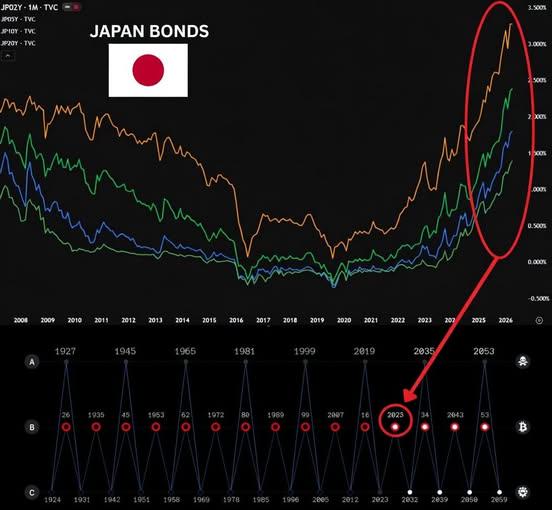
Look at Japanese government bonds right now: 10-YEAR: 2.39% 20-YEAR: 3.27% 30-YEAR: 3.68% 40-YEAR: 3.87% These are all-time highs across the curve. Japan — the world’s largest creditor nation — holds roughly $3.7 𝐓𝐑𝐈𝐋𝐋𝐈𝐎𝐍 in net foreign assets. Now add this: Swap markets are pricing nearly a 70% chance that Japan hikes rates to 1.00% by April. Read that again. If Japan reaches 1.00%, it signals the end of the global cheap-money hub. And that changes everything. For decades, Japan has been the funding engine. Investors borrowed ultra-cheap yen and deployed it into U.S. stocks, credit markets, tech, and crypto. That trade only works when money is cheap. When Japanese rates rise, that engine starts to stall. Even a small shift of that $3.7 𝐓𝐑𝐈𝐋𝐋𝐈𝐎𝐍 back into domestic assets forces selling somewhere else. Now connect the dots: China has already been reducing exposure to U.S. Treasuries. If Japan begins doing the same — even gradually — it becomes a real capital shift, not just headlines about de-dollarisation. And when the largest pools of capital stop supporting the dollar system the same way, markets don’t drift — they reprice. That’s why bonds matter first. Not because of “rate talk”, but because they determine where trillions of dollars flow. When that flow changes, liquidity tightens — and risk assets stop behaving normally. This is not a small move. This is how regime shifts begin. Quietly. In bonds. Before anyone looks up from the crypto chart. I’m watching this closely into April. Because this is exactly how major transitions start — slowly at first, then all at once.
1
0
2d •
Trading updates | 5 April 2026
1) XCN Showing Strong Bullish Signals | Major Push Ahead 2) Chiliz (CHZ) at Critical Resistance — Will Buyers Break Through? 3) Beefy (BIFI) Chart Signals a Massive Breakout — Big Move Ahead 4) Ondo Coin Analysis — Why Patience Matters Right Now 5) JASMY is Waking Up — A Massive Move Might be Close! 6) Zcash (ZEC) Analysis: Buyers Back in Control After Crash 7) Fetch.ai (FET) Market Analysis: Support Strong, Bulls Gaining 8) PEPE Coin Ready to Move — Big Pump Loading Soon? 9) XRP Consolidates at Key Demand | What Comes Next? 10) ICP Holding Key Zone — Upside Momentum Building
1
0

2d •
BREAKING: A NEW KIND OF WAR IS BEING FUNDED — AND IT’S USING THE DOLLAR ITSELF
The Islamic Revolutionary Guard Corps is funding operations against the United States using a digital token called Tether (USDT). This token is pegged to the US dollar. It mirrors the dollar. It represents the dollar. But it doesn’t move like the dollar. It runs on the TRON blockchain. Transactions settle in seconds. No American bank. No SWIFT system. No New York clearing. And critically — no direct control from the Federal Reserve. The result? The name of the dollar is now attached to a financial system operating completely outside American reach. And for the first time in history, a currency is effectively funding both sides of a war at the same time. . THE HORMUZ TOLL SYSTEM IS LIVE According to Bloomberg (April 1), the IRGC is actively collecting tolls from ships passing through the Strait of Hormuz. Here’s how it works: • A tanker operator contacts an IRGC-linked intermediary • Submits full vessel details: ownership, cargo, crew, destination • Iran’s Hormozgan command assigns a “friendliness score” (1–5) based on ties to the US or Israel • If approved, a toll is negotiated Pricing: • Starts at $1 per barrel • Can reach up to $2 million per supertanker Payment options: • Chinese yuan via CIPS • Or USDT via TRON Once payment is confirmed: • A passcode is issued over VHF • An IRGC patrol escorts the ship through a controlled corridor This is not theory. This system is active — and generating revenue right now. . THIS SYSTEM WAS BUILT BEFORE THE WAR This didn’t appear overnight. According to Chainalysis: • Iran moved $3 billion through crypto in 2025 By late 2025: • IRGC-linked wallets made up over 50% of Iran’s crypto activity According to Elliptic: • Iran’s central bank held $507 million in USDT And TRM Labs found: ~$1 billion flowed through two UK-registered exchanges: • Zedcex • Zedxion • Almost entirely in USDT on TRON TRM called it: > “A sanctioned military organization operating its own crypto infrastructure offshore.” On January 30, 2026, the Office of Foreign Assets Control sanctioned those exchanges.
1
0
1-30 of 112