
Pinned
9d •
START HERE
🧬 Welcome to The Compound Lab Your Research Starts Here. We're glad you're here. Follow these 4 steps to get plugged in: ✅ STEP 1: Introduce Yourself Drop a comment below — tell us who you are, what brought you here, and what your goals are as a Compound Researcher. Ask any questions you have. We're all here to help. 📚 STEP 2: Head to the Classroom Tab This is where your education begins. Start with Module 1 and work your way through our in-depth research compound breakdowns, biohacking science, and compliance training. 🔬 STEP 3: Check Out Our Verified Vendors Every vendor in our network is COA certified and fully research compliant. No guesswork — just trusted sources for serious researchers. For research purposes only. Not for human consumption. 💰 STEP 4: Get Your Affiliate Link Ready to earn? Once you're a verified researcher, our vendors will assign you a personal affiliate link so you can earn recurring commissions sharing what you already know. "Learn it. Source it. Share it. Earn from it." 🧬 Welcome to the family — now let's get to work.
52m •
MuSK-MG and POTS
Looking for advice on anything that may help with Muscle-Specific Kinase Myasthenia Gravis (MuSK-MG) and Postural Orthostatic Tachycardia Syndrome (POTS.
0
0
8h •
🧬 Your Skin Has a Secret Anti-Aging Molecule — And It Controls 31% of Your Genes
There's a tiny molecule your body makes naturally called GHK. It's only three amino acids long, found floating around in your blood, saliva, and tissues. Here's the wild part... researchers discovered it can influence the expression of over 4,000 human genes. That's roughly 31% of the entire human genome. And the pattern it pushes gene expression toward? Younger, healthier tissue. GHK works by binding to copper and delivering it where your body needs it most. That copper connection is why you'll often see it written as GHK-Cu. It tells your cells to ramp up collagen production, activate DNA repair genes, boost your natural antioxidant defenses, and even calm down inflammation. It's basically a reset signal that nudges your cells back toward how they functioned when you were younger. Here's the part that really stands out 👇 ✅ Levels drop by more than half as you age, going from around 200 ng/mL at age 20 to about 80 ng/mL by age 60 ✅ One study found it could reverse the gene expression signature of aggressive colon cancer, turning up tumor suppressor genes and turning down oncogenes ✅ It's one of the few peptides with enough real-world data that you can already find it in commercial skincare products What makes GHK fascinating is that something so small can orchestrate such a massive biological response. Three amino acids influencing thousands of genes. Nature is efficient like that. What other compound have you come across where the science just made you stop and think "how is this not bigger news"? For research purposes only.
0
0
12h •
💬 What's the One Thing About Your Health You Refused to Accept as 'Just Getting Older'?
We all have that moment. Maybe it was the brain fog that wouldn't lift no matter how much sleep you got. Maybe it was a nagging injury that just stopped healing the way it used to. Or maybe you looked in the mirror one day and thought "this doesn't match how I feel inside." For a lot of people in this community, that moment is what started the deep dive. You Googled one thing, found a study on something like BPC-157 or GHK-Cu or NAD+, and suddenly you're three hours into PubMed at 2am wondering why nobody told you about this stuff sooner. That's not obsession, that's curiosity meeting real science. So here's what I want to know 👇 ✅ What was YOUR moment? The thing that made you say "there has to be something better"? ✅ What are you most curious about right now, whether it's recovery, cognition, energy, skin, sleep, or something else entirely? ✅ What's one thing you wish you had known five years ago? Drop your answer below. No wrong answers here. Some of the best conversations in this community start with someone saying "I had no idea that was even possible." Let's hear your story. For research purposes only.
0
0
17h •
🔬 Your Gut Has Its Own Anti-Inflammatory Molecule — And It's Only 3 Amino Acids Long
Most people think of inflammation as something you fight with pills or supplements from the outside. But your body already makes one of the most powerful anti-inflammatory molecules ever studied. It's called KPV, a tiny fragment from a larger hormone called alpha-MSH. What makes KPV wild is that it's only three amino acids long, basically the smallest functional peptide your body produces, and yet it punches way above its weight. Here's how it works. Inside your cells, there's a master switch called NF-kB that controls inflammation. When NF-kB flips on, your body floods with inflammatory signals like TNF-alpha and IL-6. KPV actually gets inside cells and blocks NF-kB from turning on in the first place. It doesn't just reduce inflammation after it starts, it stops the process at the source. Most peptides can't even get through cell walls on their own, but KPV is so small it walks right in. Here's what the research has found 👇 ✅ In gut inflammation models, KPV reduced inflammatory markers by over 70 percent when delivered directly to damaged tissue ✅ Unlike most peptides that break down in stomach acid, KPV's tiny size makes it remarkably stable through the digestive system, and oral administration actually worked in multiple studies ✅ Beyond the gut, researchers have also found it has direct antimicrobial activity against bacteria like Staph aureus and even Candida The gut health research community has been especially interested in KPV because finding a peptide that survives digestion AND targets the central inflammatory pathway in the GI tract is genuinely rare. If you've ever wondered how your body keeps gut inflammation in check naturally, this little tripeptide is a big part of that story. What surprises you more, that something this small can be this powerful, or that your body was making it all along? For research purposes only.
0
0
1-30 of 44
skool.com/thecompoundlab
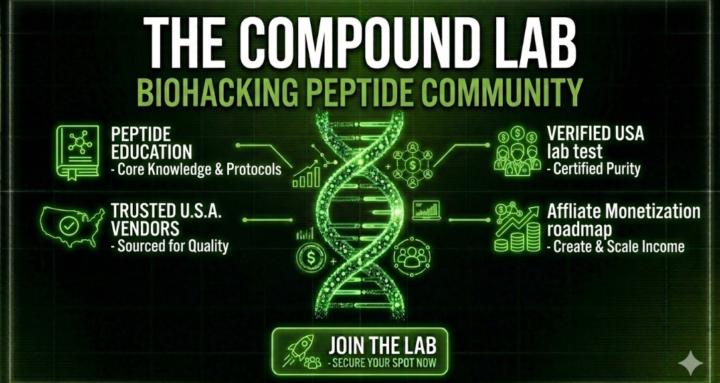
Private biohacking community for peptide education, trusted sourcing, and ethical affiliate monetization. Education-first.
Leaderboard (30-day)
1

+6
2
+4
3

+4
4
+4
5

+3
Powered by