Activity
Mon
Wed
Fri
Sun
May
Jun
Jul
Aug
Sep
Oct
Nov
Dec
Jan
Feb
Mar
What is this?
Less
More
Owned by Des
MSc Psychology & Behaviour Analyst For coaches tired of clients who 'get it' but can't do it Master the science of behaviour change
Memberships
5 contributions to Connected Through Play

🔥
21d •
The Science of Asking
In an achievement-driven world, we often use questions to "check for understanding." We ask things we already know the answer to ("What color is that? How many blocks are there?") just to see if our kids know it, too. This puts them in the "hot seat" and reinforces the idea that their value is tied to being "correct." But the most powerful questions are the ones where you don’t know the answer. When we ask curiosity-led questions, we move from being a judge to being a co-explorer. This creates a safe space for "The Muck" that messy middle ground where ideas are formed and mattering is felt. By changing how we ask, we give our children the freedom to wonder out loud. Your challenge today is to go the entire day without asking a "closed" question (one that can be answered with a simple 'Yes,' 'No,' or a single fact). Your Tool: "Notice & Wonder" If you get stuck, use these two simple sentence starters: 1. "I noticed that..." (Observation) 2. "I wonder..." (Curiosity) The Special Twist: The "Three-Second Rule" After you ask a question, count to three in your head before saying anything else. This "wait time" gives your child’s brain the space to move from performance-panic to creative thought. Tips for Tailoring Your Questions by Age: Ages 3–5 (Sensory Search): Connect their bodies to the moment. Example: "I noticed the mud feels squishy today. I wonder what would happen if we added more water?" Ages 6–8 (Logic Bridge): Explore how things work without the pressure of being right. Example: "I noticed the tower fell toward the left. I wonder what we could put on the right side to balance it out?" Ages 9–11 (Perspective Pivot): Building empathy and systems thinking. Example: "I noticed that character seemed really quiet in that scene. I wonder what they were thinking that they didn't say out loud?" Ages 12–14 (Agency Anchor): Giving them the "steering wheel." Example: "I noticed you have a lot on your plate this week. I wonder what part of the schedule feels the heaviest to you right now?"


3 likes • 20d
I think it's very important to give the time for process time, which is something I teach about. A really nice part here is shifting to noticing the event, item, or thought. That's something which is also starting to teach psychological flexibility, which is an absolute need for kids in brain development terms. The right ventrolateral prefrontal cortex and the development of linguistic knowledge around emotions are incredibly important, and we use an awful lot of those observer perspective-taking tools to start to achieve this. You are constantly modelling to your children and using those sorts of noticing to provoke thought skills. These are incredibly important for child brain development. Loving what you're doing here! Interestingly, I seem to have arrived on a week which is perfect for me. I really like maths.
🔥
21d •
Decoding the Noise (Data & Probability)
We live in a world of "Big Data." Every day, we, along with our kids are hit with statistics, "trends," and algorithms. The most important math skill for a modern adult isn't long division, it’s the ability to look at a number and ask, "Is this actually true, or is it just a fluke?" Probability is the math of "What if?" It teaches kids to manage expectations and understand risk. When we play with probability, we help them move from "black and white" thinking to a more nuanced understanding of the world. We are teaching them to be critical consumers of information, rather than passive recipients of "facts." Time to apply this at home! Let’s play “The Kitchen Coin Toss” where we see if "random" is actually as random as it seems. Gather Your Gear: A coin and a piece of paper. Get Started: 1. Ask your child: "If I flip this coin 20 times, how many heads will I get?" Most will say 10. 2. Have them flip the coin 20 times and record the results. 3. If the result isn't 10/10 (it rarely is), ask them why. Does the coin have a "favorite" side? Does the person flipping it have a "lucky" thumb? 4. Try to "rig" the results. Can you flip it in a way that always produces tails? Options for Older Kids: For Ages 12–14: The Sports Stat Audit. Pick a favorite athlete. Look up their "average" for a season. Then look at their last 5 games. Why is there a difference? Does the "average" tell the whole story, or is it hiding the "slumps" and "streaks"? For Ages 15–17: The Algorithm Audit. Have them spend 5 minutes on their favorite social media feed and count how many "suggested" posts relate to a single topic. Ask: "What data did you give the app to make it 'guess' that you like this?" This is probability used by tech to predict human behavior. Your Turn: What was your 20-flip ratio? Did your "older" kids find the Algorithm Audit eye-opening or annoying? How about you, did you try the algorithm audit on your favorite social media? What did you learn?

3 likes • 20d
I love the social media audit, highlighting to kids about how their interactions can influence what adverts they see!
🔥
22d •
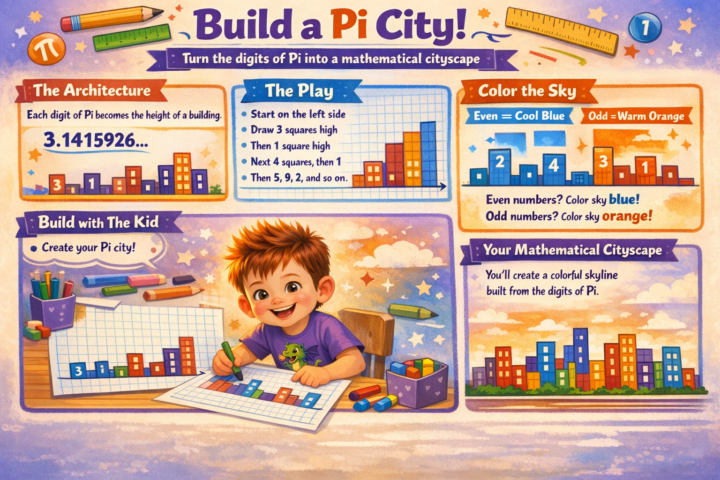
The Pi-Line Skyline
Let’s turn the invisible digits of Pi into a tangible piece of art. Of course, you can do this any day, Pi day is just special. Gather Your Gear: Graph paper (or any paper), markers, and a list of the first 10–15 digits of Pi: 3, 1, 4, 1, 5, 9, 2, 6, 5, 3, 5... Get Started: The Architecture: Each digit of Pi represents the "height" of a building. The Play: Starting on the left side of the paper, draw a bar (a building) that is 3 squares high. The next building is 1 square high. The next is 4, then 1, then 5, and so on. The Result: You will end up with a "Mathematical Cityscape." The Special Twist Color the "sky" based on a pattern. If a building's height is an even number, color it cool blue. If it’s an odd number, color it warm orange. This helps kids visualize the "randomness" of the infinite digits. For Older Kids (12-17): The Buffon’s Needle Challenge This is a classic "mind-blown" math trick. Drop a bunch of uniform items (like toothpicks or unsharpened pencils) onto a floor with parallel lines (like hardwood or tile). There is a specific formula involving the number of items that cross a line that can actually estimate the value of Pi. It’s a way to find a universal constant using just "random" drops. Your Turn: Post a photo of your Pi Skyline! How many digits did your family make it through before you ran out of paper?
3 likes • 22d
Fantastic Great ideas Thank you 🙏
🔥
22d •
Welcome New Members
I’d like to extend a warm welcome to our newest community members @Mubarak Olamilekan, @David Iya, @Andrea Quintal Portas, and @Des Cooke! Come in, relax, and take some time to explore. Getting started is as easy as 1, 2, 3. 1️⃣ The Start Here classroom has getting started tips. 2️⃣ The General Discussion is more educational/information. 3️⃣ Play Prompts & Ideas and Games, Games, Games have activities and ideas. We’d love to get to know you so please introduce yourself here or in Introductions when you are ready.

3 likes • 22d
Thank you so much! I'll be looking at that soon. My name is Des. I am a behaviour analyst, and I'm slightly older. So the next thing I'm looking at would possibly be grandkids.
2 likes • 22d
@Daniel Cavaretta thank you
🔥
22d •
Happy Pi Day!
The Magic of the Infinite! Today we celebrate \pi (3.14...), the mathematical constant that represents the ratio of a circle's circumference to its diameter. But for a child, Pi isn't just a number, it’s a gateway to The Infinite. Pi is an irrational number, meaning it goes on forever without ever settling into a repeating pattern. There is something deeply moving about the fact that a simple, perfect circle contains a number that never ends. In an achievement culture that demands "finality" and "closure," Pi reminds us that some things in the universe are beautifully incomplete. Today, we aren't worrying about calculating the area of a circle for a test; we’re just marveling at the fact that math is a language that can describe infinity. How will you “celebrate” Pi day?

2 likes • 22d
Of course. I'm a techie, and I missed that. Unbelievable! Brilliant! Thank you!
1-5 of 5
@des
Behaviour Analyst | Become an even better coach | Learn the science of transformation | 30+ years of experience | Click the link 🔗 join our community
Active 3h ago
Joined Mar 14, 2026
skool.com/rewire
Powered by